Nautilus
The Nautilus is far more than a submarine; it is the physical manifestation of Captain Nemo's genius, his rebellion, and his isolation. Built in secret from parts sourced across the globe and assembled on a deserted islet, this "phenomenon made by the hand of man" is a self-sufficient world that allows its creator to sever all ties with the land and live entirely within the sea. For Professor Aronnax and his companions, it becomes a mobile prison, a research vessel, and a witness to wonders and horrors alike.
Design and Construction
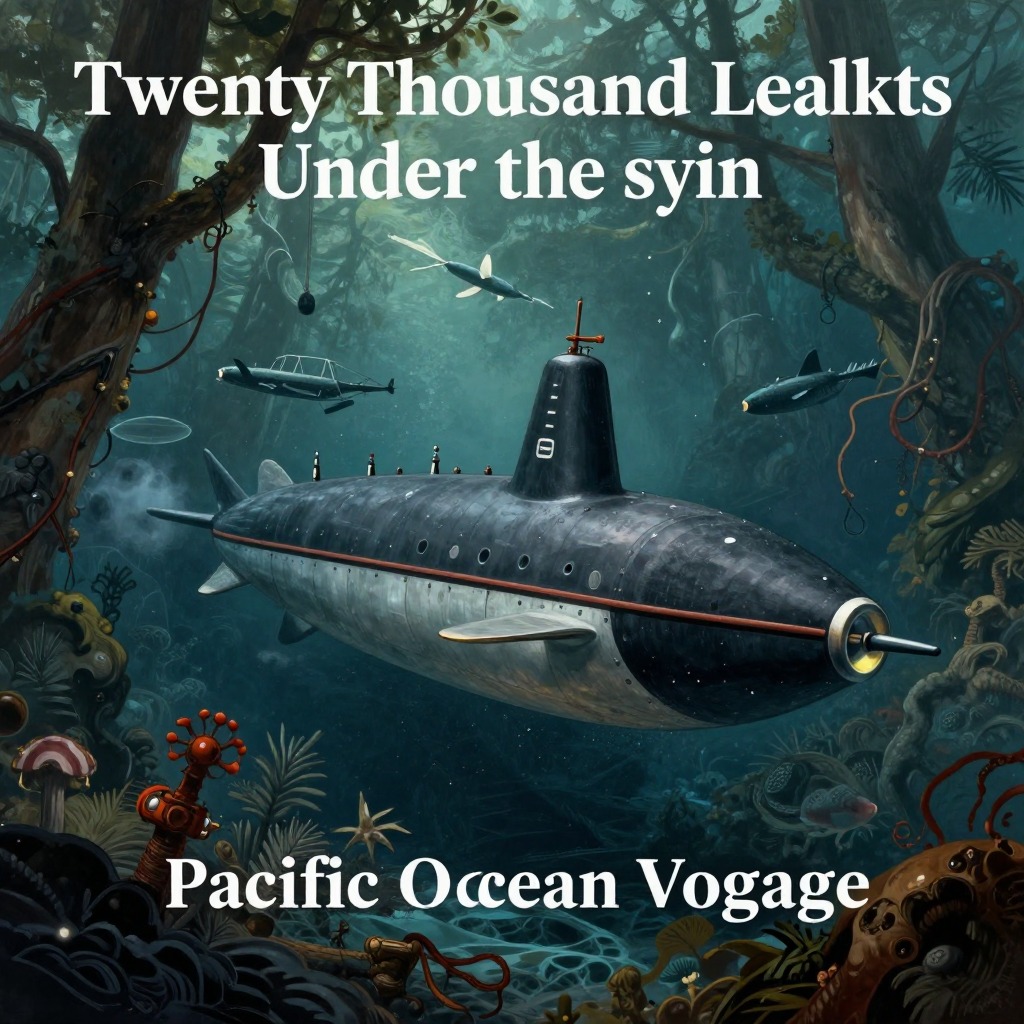
The Nautilus is a marvel of 19th-century engineering, decades ahead of its time. It is a long, cigar-shaped cylinder, seventy meters in length and eight meters at its maximum breadth, with a displacement of 1,500 metric tons (E00921-E00922). Its strength comes from a double hull of boilerplate steel, joined by iron T-bars, giving it the resistance of a solid block . The ship's construction was a global enterprise: its keel was forged by Creusot in France, its propeller shaft by Pen & Co. in London, its hull plates by Laird's in Liverpool, its engine by Krupp in Prussia, and its precision instruments by Hart Bros. in New York, all delivered to a cover address . The final assembly was completed in secret on a deserted islet, which was then burned to hide all traces . The total cost of the vessel, including its collections and works of art, was estimated at four to five million francs .
Power and Propulsion
The Nautilus is powered entirely by electricity, a force Captain Nemo describes as "powerful, obedient, swift, and effortless" . He generates this electricity not from conventional batteries but by extracting sodium from seawater, using coal mined from underwater coalfields to process it . This electrical system provides light, heat, and motion, and even powers the ship's pumps and weapons. The propeller, driven by huge electromagnets, can achieve a speed of fifty miles per hour (E00911-E00913). The ship's maneuverability is enhanced by slanting fins attached to its sides, which allow it to move on a vertical plane, diving or rising on a diagonal . For precise depth control, the Nautilus uses ballast tanks that can be filled with water to submerge or emptied to rise .
Interior and Amenities
The interior of the Nautilus is a luxurious and functional space, divided into several compartments separated by watertight bulkheads . It includes a grand dining room, a library containing 12,000 volumes, and a magnificent lounge-museum filled with priceless art and natural history specimens . The ship also features a smoking room where cigars made from nicotine-rich seaweed are enjoyed , a galley where electricity does most of the cooking, and a bathroom with hot and cold running water . The crew's quarters and the engine room are located aft (E00904-E00905). The Nautilus is also equipped with a skiff, a light and unsinkable longboat stored in a cavity on the hull, which can be used for excursions and fishing trips (E00894-E00896).
Life and Operations Aboard
Life aboard the Nautilus is governed by the sea. The crew, a multinational group of men who have also cut ties with the land, dress in clothes woven from seashell filaments and eat a diet consisting entirely of marine products, including turtle loin, dolphin liver, sea cucumber preserves, and milk from cetaceans . The ship's air is renewed by rising to the surface like a cetacean, and powerful pumps store air under pressure for extended dives . The Nautilus is also a formidable weapon. Its hull is impervious to cannon fire, and its bow is armed with a steel spur capable of piercing the hull of a warship . The ship's hatches can be electrified to repel boarders, a defense that proves effective against Papuan natives .
Narrative and Thematic Significance
The Nautilus is the central, unifying element of the novel. It is the vehicle for the underwater tour of the world, enabling the exploration of coral forests, the discovery of Atlantis, the journey to the South Pole, and the observation of countless marine species. At the same time, it is a prison for Aronnax, Conseil, and Ned Land, a symbol of their lost freedom and the source of their constant tension with Captain Nemo. The ship itself reflects its captain's dual nature: a marvel of scientific achievement and a tool for implacable vengeance. Its final fate, caught in the Maelstrom off the Lofoten Islands, remains unknown, leaving the reader to wonder whether the Nautilus and its enigmatic commander survived the ocean's most fearsome whirlpool .